THE FLAVOR
Savory, with a little sweetness
Seasoning and richness vary by shop.
TAIWAN, ONE DISH AT A TIME
A little bowl.
A lot of Taiwan.
Lu rou fan is a good place to begin understanding Taiwan’s everyday food culture. Affectionately called its “national rice dish,” it earns that nickname through familiarity, not an official title. A small bowl can be a quick meal on its own, or the start of lunch with soup, greens, and a braised egg. Its significance is not reserved for special occasions: this is food that fits into ordinary life.
The ingredients are modest—rice, chopped or diced pork, soy sauce, and often shallots—but the result is deeply personal. One shop favors soft, fatty pieces; another a leaner topping or a sweeter sauce. Those differences are part of the appeal, not departures from a single correct recipe. For a visitor, tasting a bowl is a way into that local conversation. Start with the flavors and ordering tips here, then follow the MRT to a shop in this guide.
70 places to explore • DISHES & PLACES
 Dish photo unavailable
THE FLAVOR
Seasoning and richness vary by shop.
THE TEXTURE
Look at the balance of fat, lean meat, and rice.
THE MOMENT
Add soup or sides where the menu offers them.
THE GUIDE MEETS THE TABLE
Choose an MRT area or station, compare the bowls, and open a shop page for dish details and directions.
Station codes and line colors match the selected MRT area.
70 shops in this selection
Dish photo unavailable
BL07Banqiao · 板橋Taipei / New Taipei / Bannan Line
魯肉飯
海山魯肉飯
Haishan Lu Rou Fan
The braised pork has a higher proportion of fatty meat and a glossy surface. The rice keeps its chew, absorbing the sauce without turning mushy.
See this dish at the shop Dish photo unavailable
BR14Dazhi · 大直Taipei / New Taipei / Wenhu Line
魯肉飯
明水397食堂
Mingshui 397 Eatery
Glossy minced pork has a slight stickiness, and its aroma lingers after the first bite. This bowl best reflects the eatery's home-style character.
See this dish at the shop Dish photo unavailable
BR07Liuzhangli · 六張犁Taipei / New Taipei / Wenhu Line
阿嬤滷肉飯
老童小吃部
Lao Tong Xiao Chi Bu
The thick braising sauce has a gelatin-rich texture. Fatty and lean pork bring fragrance and substance to the rice, while pickled radish adds a refreshing contrast.
See this dish at the shop Dish photo unavailable
BL03Tucheng · 土城Taipei / New Taipei / Bannan Line
滷肉飯
央二巷滷肉飯
Yang Er Xiang Lu Rou Fan
Braising sauce coats the rice as silky fat and lean meat aroma interweave, making this the clearest introduction to the shop's flavors.
See this dish at the shop Dish photo unavailable
BL04Haishan · 海山Taipei / New Taipei / Bannan Line
魯肉飯
陳家莊魯肉飯
Chen Jia Zhuang Lu Rou Fan
The savory aroma of minced pork sauce soaks into the rice. Eat it alone or pair it with braised dishes and sides from the table.
See this dish at the shop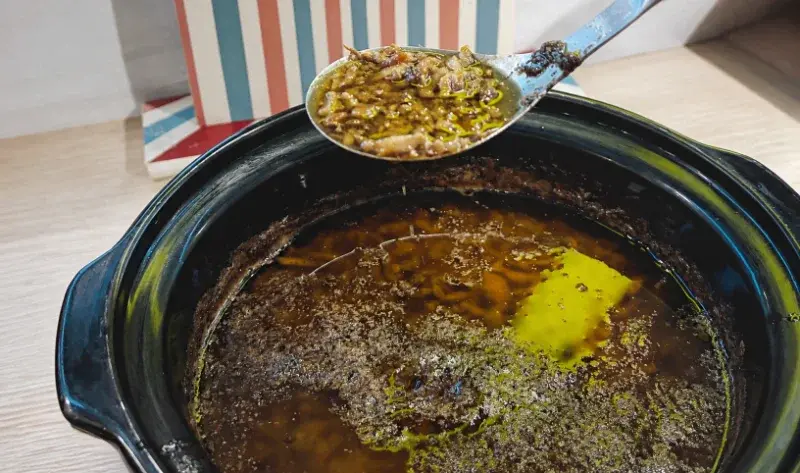 Dish photo unavailable
BL09Jiangzicui · 江子翠Taipei / New Taipei / Bannan Line
金峰魯肉飯
吉哆火鍋百匯
Gi Do Hot Pot Buffet
Spoon the minced-pork braising sauce from a large pot over rice yourself. A small bowl adds a Taiwanese staple beside the hot pot.
See this dish at the shopMenus and availability may change. Check with the shop before visiting.
A FEW WORDS GO A LONG WAY
Start with a bowl, then check the menu for a size and sides. The phrases below are questions, not a promise that every shop offers the option.
一碗滷肉飯
One bowl of lu rou fan, please.
有小碗或大碗嗎?
Do you have small or large bowls?
有滷蛋、青菜或湯嗎?
Do you have braised eggs, greens, or soup?
KNOW THE DIFFERENCE
Names are not perfectly consistent across Taiwan. The menu and the actual dish matter more than a rigid north–south rule.
Lu rou fan
Usually finely chopped or diced braised pork spooned over rice.
The balance of fat, sauce, and rice.
Rou zao fan
A name used for related minced-pork rice, particularly in parts of southern Taiwan.
Check the photo rather than assuming a completely different dish.
Kong rou fan
Usually a larger slice or chunk of braised pork with rice.
The cut, portion, and fat-to-lean balance.
GO A LITTLE DEEPER
The size of the pork pieces, the strength of the sauce, and the sides all give a bowl its character. Start by finding the balance you enjoy, rather than trying to name a single best version.
Lu rou fan fits different appetites: a bowl on its own, or a meal with greens, a braised egg, and soup. It can be the lunch around the corner or a familiar break in a working day, not just something to try while sightseeing. Everyday meals like this offer a welcoming way to get to know Taiwan.
Soft fat, lean-meat fibers, and the aroma of shallots or other seasonings can give each bowl a different character. Rice catches the sauce. Notice whether the grains retain some bite after mixing and whether the last spoonful feels balanced, rather than judging only how much pork is on top.
Names vary between regions and shops, so they do not form an absolute north–south rule. Look first for finely minced pork, small cubes, or a larger piece with visible layers of fat and meat. Comparing the menu with the actual dish is more useful than memorizing one English translation.
Some versions add an egg or fish, or use a different meat. A familiar name does not guarantee an identical recipe. Read the actual dish name and the shop’s description. For a simple introduction, start with braised pork and rice, then explore other combinations.
No single fat-to-lean ratio applies to every shop. Some bowls are richer and more gelatinous, others leaner. Read the actual dish notes and ask if you are unsure.
The names overlap in some places, but usage varies. Look at the size of the pork pieces and the shop’s own description instead of relying on the name alone.
Start by checking the available portions. If you would like a fuller meal, look for soup, greens, or a braised egg on the menu. Choices vary by shop.
KEEP EXPLORING
Compare another Taiwan flavor, or return to the MRT food finder.